


Candi – Microsoft Blog Post – Read Microsoft Case Studies, Customer Success Stories and other information regarding Microsoft Azure, Applications, AI, IoT, Data
Incredible Real-World Applications Prove the IoT Is Here to Stay

As author Peter Daisyme accurately puts it, “While many people debate whether little computers in wrist devices, clothing, refrigerators and vehicles will truly change our lives, actionable change is already occurring on the business application side of the IoT.” Regardless of which side of the argument you’re on, the impact the IoT is having in our societies at a macro level is undeniable.
While you’re reading this, devices that measure and predict air pollution, vehicle traffic levels, machine failure rates, fire warnings, and crime rates are being employed to improve the lives of hundreds of thousands of people. And as cities and businesses become more interconnected by the hour, we’ll find more and more useful ways in which the IoT can help us better utilize our resources and lift the burden we put on our environment.
In this article, you’ll gain deeper insights into how IoT devices are being used by companies and governments alike to obtain accurate data across many potentially life-saving use cases. You’ll also learn about what the future holds in store for us as cities powered by artificial intelligence become near-sentient beings capable of reacting in real time to the habits and living conditions of their inhabitants.
- Published in Microsoft
The 4 defining characteristics of effective digital workspaces

Not so long ago, it was believed that for teams to be productive, they required long hours confined in a physical office space with constant face-to-face interaction. To be fair, given the primitive state of digital collaboration tools at the time—which was pretty much limited to emails—there wasn’t really a solid alternative to this scheme, so companies worked with what they had.
Today, digitalization has made it possible for several people to seamlessly work together while being halfway across the world from each other. Exponential advancements in virtual workspaces have not only enabled teams to work as well as they did when they spent all day in the office, but have also proven that people are actually more productive the less they have to deal with alienating cubicles and two-way trips along traffic-congested highways.
Not all digital workspaces have been equally effective, however. Yet decades of iterating and optimizing have finally given us a solid idea of the most important characteristics these spaces must have to reach their full potential. So what are they? Read this infographic to find out.
View: The 4 defining characteristics of effective digital workspaces
- Published in Microsoft
The 4 defining characteristics of effective digital workspaces

Not so long ago, it was believed that for teams to be productive, they required long hours confined in a physical office space with constant face-to-face interaction. To be fair, given the primitive state of digital collaboration tools at the time—which was pretty much limited to emails—there wasn’t really a solid alternative to this scheme, so companies worked with what they had.
Today, digitalization has made it possible for several people to seamlessly work together while being halfway across the world from each other. Exponential advancements in virtual workspaces have not only enabled teams to work as well as they did when they spent all day in the office, but have also proven that people are actually more productive the less they have to deal with alienating cubicles and two-way trips along traffic-congested highways.
Not all digital workspaces have been equally effective, however. Yet decades of iterating and optimizing have finally given us a solid idea of the most important characteristics these spaces must have to reach their full potential. So what are they? Read this infographic to find out.
View: The 4 defining characteristics of effective digital workspaces
- Published in Microsoft
5 reasons to empower governments with digital transformation
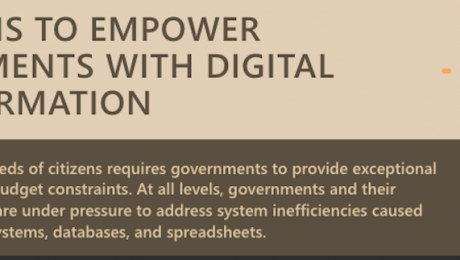
Delivering the best services possible to citizens while managing tight budgets is an everyday struggle for public institutions. Although this is also true for many privately owned companies, a slight delay or inefficiency in public services can spell disaster for entire families. Yet keeping up with digital transformation can be difficult for such institutions thanks to nightmarishly long bureaucratic processes and archaically old existing architectures. This means that once a digital strategy gets approved, there’s little to no room to get things wrong. When thing do go the right way, however, governments and public institutions are empowered with unparalleled efficiency that translates into a better quality of life for all citizens.
In this infographic, you’ll learn how digital transformation strategies can greatly improve the effectiveness of public services and significantly enhance taxpayers’ overall perception of the institutions that implement them.
View: 5 reasons to empower governments with digital transformation
- Published in Microsoft
The 3 phases of an effective IoT strategy
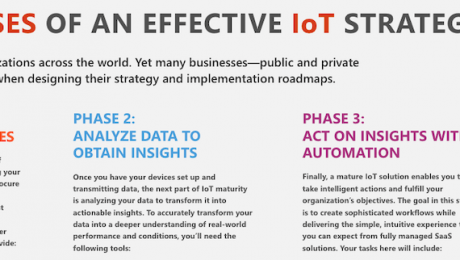
IoT is quickly becoming the most important business revolution of the digital age, with its implications being felt across all industries worldwide. However, unlocking the true potential of IoT requires not only a clear roadmap with specific objectives, but also a solid front-end and back-end infrastructure that’s capable of making sense of the data obtained. It’s for this reason that both public and private organizations sometimes struggle when implementing a successful IoT strategy and fail to reach the desired return-on-investment (ROI).
To address the risks you may encounter with IoT, we’ve created this short, insightful infographic. After reading it, you’ll have a better idea of the tools and actions you should be executing during each of the three stages of IoT implementation to overcome challenges and maximize effectiveness. You’ll also obtain a straightforward checklist that your teams can refer to when establishing or optimizing their strategies.
- Published in Microsoft
The 3 phases of an effective IoT strategy
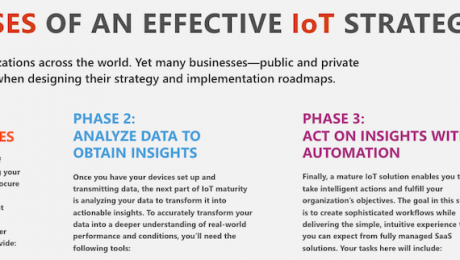
IoT is quickly becoming the most important business revolution of the digital age, with its implications being felt across all industries worldwide. However, unlocking the true potential of IoT requires not only a clear roadmap with specific objectives, but also a solid front-end and back-end infrastructure that’s capable of making sense of the data obtained. It’s for this reason that both public and private organizations sometimes struggle when implementing a successful IoT strategy and fail to reach the desired return-on-investment (ROI).
To address the risks you may encounter with IoT, we’ve created this short, insightful infographic. After reading it, you’ll have a better idea of the tools and actions you should be executing during each of the three stages of IoT implementation to overcome challenges and maximize effectiveness. You’ll also obtain a straightforward checklist that your teams can refer to when establishing or optimizing their strategies.
- Published in Microsoft
McCann & MullenLowe – Microsoft Teams Case Study

When bringing two companies together through acquisitions, you are often bringing in a different culture with different technology. This can often make it difficult to efficiently collaborate. Sharing files and streamlining communication is a common problem. Two of the leading agency networks, McCann and MullenLowe, needed help to create a single platform which enabled their employees to work together through close collaboration. Microsoft Teams provided the solution they were looking for.
- Published in Microsoft
App migration to Azure

In this video, look at strategies to migrate to Microsoft Azure spanning zero to higher levels of coding and when to use which.
From rehosting your apps by lifting and shifting them to Azure to choosing to refactor your apps for greater efficiency, Azure offers you possibilities. You can also rearchitect your apps to be able to quickly add new capabilities or take a cloud-native approach by rebuilding them from scratch. This video also addresses Azure’s new secure options in the wake of the end-of-support for Windows Server 2008 R2 or SQL Server 2008.
- Published in Microsoft
Replace labor redundancy and manual tasks with digital efficiency. Subscribe now to learn more.

Digital technology has forever changed the dynamics between customers and companies. Companies must continually reinvent their business by going one step ahead of ever-evolving digital trends or risk becoming silent observers while their industry is led by other businesses more adept at digital transformation.
Subscribe now to learn how your business can leave behind inefficient processes, duplicate tasks, and a reliance on physical workplace tools to become an active player in today’s digital game.
- Published in Microsoft
A digital workspace that transforms ideas into revenue. Subscribe now to learn more about Microsoft Teams.

Innovative ideas are an organization’s greatest asset. Yet these assets need the appropriate space to grow, evolve, and transform into revenue-generating initiatives. Whether digital or physical, today’s workplaces need to harness the synergy of everybody involved and empower them to share and collaborate in an environment that fosters productivity. These workplaces also need to adapt to everybody’s needs and remain intuitive for the entire team, regardless of age, background, or gender.
Subscribe now to stay current on the latest digital workplace trends, and discover how you can foster inclusion and innovation across your business with the help of Microsoft.
- Published in Microsoft